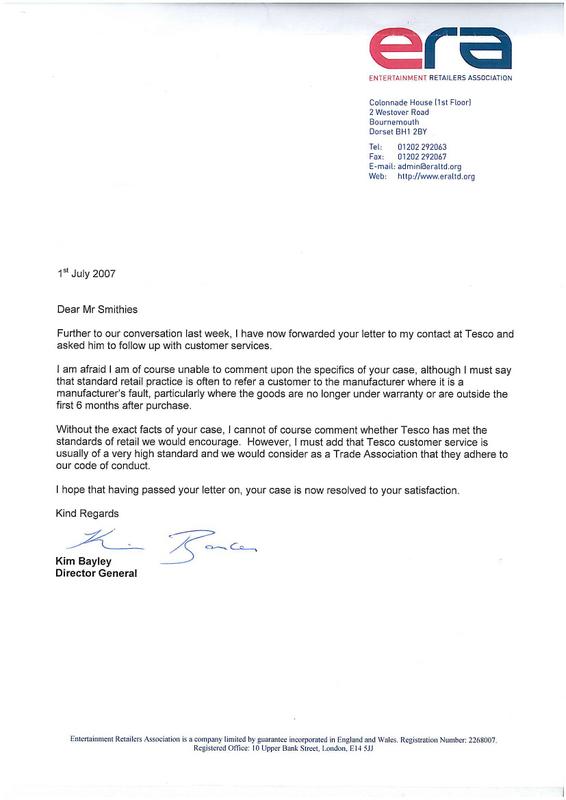
Dear Sam,
I
am writing to you regarding
an Xbox 360 that was purchased
from a Tesco on the 2/12/05
(a copy of the receipt is
enclosed). After being advised
by the very helpful and polite
staff both in store and on
the helpdesk, I was given
your name.
The
machine has suffered a hardware
failure (often referred
to as the ‘red ring of
death’, as the machine
displays this by lighting
three quadrants on the front
panel with red lights).
This is actually the second
time this has occurred.
The first time I sent the
machine back to Microsoft
to be repaired.
I have included copies of
the e-mails, dated August
14th 2006, August 16th 2006
and August 17th 2006 from
Microsoft repair department
for your information.
After
a further 9 months, it has
failed again. I have been
advised that the best course
of action is to seek a replacement
from the retailer I originally
bought the equipment from.
I
understand that it is your
company policy to offer a
12-month warranty on all
electrical goods, and I also
understand that my complaint
falls outside of this timeframe.
However, I believe as a consumer
I am still covered by the
Sale of Goods Act (1979)
and the Sale and Supply of
Goods Act (1994), specifically
section 14 of the Sale of
Goods Act 1979, which details
the quality and fitness for
purpose of goods on sale
to the public. Whilst I am
sure you are well aware of
these regulations, a copy
of the relevant clause can
be found on the link below,
on the Office of Public Sector
Information website.
http://www.opsi.gov.uk/acts/acts1994/Ukpga_19940035_en_1.htm [1]
I
feel the most salient points
of this act are covered
on the Department of Trade & Industry
website
http://www.dti.gov.uk/consumers/fact-sheets/page38311.html)[2]
After
directing a member of your
customer service team to
The DTI site, they agreed
that the onus of responsibility
is on the retailer for a
period of up to 6 years.
They also agreed that a
games console that cost £279.97
at the time of purchase
should reasonably last longer
than 18 months (or the two
9 months mine has lasted!).
Incidentally,
I have had a Playstation
1 for 12 years, a Playstation
2 for almost 7 years, and
an Xbox and Gamecube for
5 years, without incident
or failure. Therefore, I
do not believe it is unreasonable
to expect a similar length
of life for an Xbox 360.
I
was asked; quite reasonably
may I add, to provide you
with some evidence that
the Xbox 360 supplied to
be ‘inherently
faulty at time of sale’.
While I cannot give you
any technical evidence, sadly
(I am really not too technically
minded and I am also not
aware of any information
supplied by Microsoft to
this effect), there is quite
a large amount of evidence
pointing to a systematic
and widespread problem within
the 360 itself.
From
one of the gaming industries
widely read and respected
news sites, an article that
was first printed on 25th
March 2007. The full article
can be found at
http://www.gamesindustry.biz/content_page.php?aid=25290.[3]
A
story that appeared in The
Guardian on Thursday 31st
March 2007 (and reprinted
on their website
http://technology.guardian.co.uk/weekly/story/0,,2091221,00.html)[4]
detailing the same problem:
From
one of the world’s
largest gaming websites
(IGN,
http://uk.gear.ign.com/articles/736/736297p1.html)
[5] news that the manufacturing
of the Xbox 360 was revised
from the beginning of this
current year, partly because
of ongoing reliability concerns.
The
problems surrounding the
unreliability of the Xbox
360 has recently been covered
by the BBC’s Watchdog
programme
http://www.bbc.co.uk/consumer/tv_and_radio/watchdog/reports/consumer_goods/consumer_20070213.shtml [6]
Finally,
from an Internet technology
news site, engadget, last
week reported that the European
Commissioner was investigating
Microsoft about the build
quality of the Xbox 360.http://www.engadget.com/2007/06/01/european-commissioner-gives-microsoft-one-week-to-respond-to-360/
[7]
I
would also be happy to supply
you with links to Internet
forums and message boards
where other users of the
360 have posted their stories
of failing machines, often
comprising of hundreds, if
not thousands, of posts.
Putting
all of this together with
my own experiences, I feel
it is reasonable to assume
that the first batch of
Xbox 360’s produced
had an inherent fault within
them, causing them to suffer
from a hardware failure,
sometimes months after first
purchased.
I
understand that this is an
unusual situation, as the
fault does not always manifest
itself until well into the
life of the equipment. I
also fully understand that
it is open to opinion about
how long a piece of electrical
equipment should reasonably
last. It is my opinion that
a reasonably expensive, high-end
piece of consumer equipment
should last longer than 18
months. Indeed, since it
has already been repaired
once, halfway through this
period, I can only deduce
that this problem cannot
be permanently fixed and
I will only face similar
issues in the future.
In
light of all this, I am requesting
that you replace the Xbox
360 that was purchased from
your company in good faith.
I am only seeking to replace
what I now believe to be
faulty goods under my rights
as documented in the Sales
of Goods Act (1979). I very
much hope a company of your
stature will honour consumer
rights.
I
trust that you find all this
satisfactory, although if
you do require any further
information, please do not
hesitate to contact me. I
look forward to hearing your
reply to this matter within
the next fourteen days.
Appendices
[1]
Sale and Supply of Goods
Act (1994) amendment to clause
14 of the Sales of Goods
Act (1979):
1.—(1) In section 14
of the [1979 c. 54.] Sale
of Goods Act 1979 (implied
terms about quality or fitness)
for subsection (2) there
is substituted—
"(2) Where the seller
sells goods in the course of a business, there is an
implied term that the goods supplied under the contract
are of satisfactory quality.
(2A)
For the purposes of this
Act, goods are of satisfactory
quality if they meet the
standard that a reasonable
person would regard as satisfactory,
taking account of any description
of the goods, the price (if
relevant) and all the other
relevant circumstances.
(2B)
For the purposes of this
Act, the quality of goods
includes their state and
condition and the following
(among others) are in appropriate
cases aspects of the quality
of goods— (a) fitness
for all the purposes for
which goods of the kind
in question are commonly
supplied, (b) appearance
and finish, (c) freedom
from minor defects, (d)
safety, and (e) durability.
[2]
Department of Trade & Industry
Website Sales of Goods
Act Quick Facts:
• Wherever goods are
bought they must "conform
to contract". This means
they must be as described,
fit for purpose and of satisfactory
quality (i.e. not inherently
faulty at the time of sale).
• Goods are of satisfactory
quality if they reach the standard that a reasonable
person would regard as satisfactory, taking into account the
price
and any description.
• Aspects of quality
include fitness for purpose, freedom from minor defects,
appearance and finish, durability and safety.
• It is the seller,
not the manufacturer, who is responsible if goods do
not conform to contract.
• For up to six years
after purchase (five years from discovery in Scotland)
purchasers can demand damages (which a court would equate
to the cost of a repair or replacement).
• A purchaser who is
a consumer, i.e. is not buying in the course of a business,
can alternatively request a repair or replacement.
[3]
Gamesindustry.biz article ‘Rings
of Red’ (25/05/07)
extract:
However,
there is another problem
which Microsoft faces at
the moment - one which the
company has shown even less
sign of understanding, or
addressing. It is the problem
of hardware reliability and
customer service, an area
in which the Xbox 360 has
a track record that is nothing
short of utterly appalling
- and an area which Microsoft
absolutely must address,
or risk handing the goodwill
of the market back to its
rivals.
Of
course, this too is not a
new problem. Microsoft has
been slammed over the failure
rate of Xbox 360 consoles,
and its own poor customer
service in dealing with that
matter, many times before
- British readers will undoubtedly
recall that the firm was
hauled over the coals on
the Watchdog programme here
only a few months ago.
This
problem hasn't gone away;
in fact, from a consumer
point of view, Microsoft
appears to have done precisely
nothing to address it. While
the attention of the media
may have turned to scrutiny
of Sony's failings, the vast
numbers of Xbox 360 owners
who have been let down first
by Microsoft's shoddy manufacturing,
and subsequently by the company's
arrogant and unfair policies
with regard to customer service,
have increased. Their voices
are contributing to a groundswell
of unrest and negative buzz
which will hurt Microsoft
very badly indeed if it is
not addressed.
The
problem is clear. A large
number of Xbox 360 consoles
from launch onwards have
shipped with manufacturing
problems which have manifested
themselves in the dreaded "three
red lights" - an error
code displayed on the front
panel which means that the
console has died, and needs
to be returned to Microsoft
for service.
The
number of systems which shipped
with these problems is a
matter of some debate, but
it's clear that it is a far,
far higher proportion than
the company originally admitted.
Early claims suggested that
Xbox 360 consoles were only
failing as often as you would
expect from any piece of
consumer hardware - a figure
generally agreed to be around
3 per cent. However, entire
batches of consoles at launch
were failing en masse - and
the reliability, although
it improved, continued to
be poor for months afterwards.
Has
this been fixed? Who can
say - Microsoft has certainly
made no promises regarding
enhanced reliability for
the Xbox 360 Elite console,
so it's simply impossible
to judge whether new machines
rolling off the production
line will be any better
than their predecessors.
Even giving the benefit of
the doubt, that still means
that millions of machines
from the "unreliable" period
of the console's manufacturing
are sitting under televisions
around the world.
[4]
Guardian article ‘What
is the real failure rate
of the Xbox 360?’ (31/05/07)
extract:
We
asked Game, one of the largest
console retailers in the
UK. "That's not information
we're able to give out. It's
commercially sensitive," it
said. As for Microsoft,
in the early days after the
console's 2005 launch it
claimed that failure rates
were no higher than an industry
average of between 3% and
5%. That now seems wildly
optimistic.
Last
month, its vice-president
of entertainment, Peter
Moore, refused to answer
the question, telling the
Mercury News: "I
can't comment on failure
rates." According to
Moore, if someone has a
faulty console they should
worry about the customer
service.
Anecdotal
evidence about how many
have suffered the "red ring
of death", where the
power button sticks on red,
not green, is hard to assess
because it is those with
faulty boxes who make most
noise, but Microsoft seems
to have a problem. A notable
feature of surveys such
as one conducted recently
by the magazine 360 Gamer
is that multiple failures
are common, with some users
on their sixth or seventh
console.
Third-party
repair specialists also
cast doubt on the 360's reliability.
Simon Donn at Undercutter
UK in London Colney, Hertfordshire,
says: "There's a particular
problem in relation to
overheating. Quite often
it's to do with the soldering
on the board, and the fact
that the fans, which are
already very loud, can't
seem to extract enough
air. "
[5]
IGN News article 28/09/06
extract:
US,
September 28, 2006 - Vnunet.com
reports today that Chartered
Semiconductor of Singapore,
manufacturer of the Xbox
360's CPU, will begin manufacturing
a new version of the chip
in Q1 2007. The current Xbox
360 CPU uses a 90-nanometer
manufacturing process, a
relatively old-fashioned
technique compared to the
cutting edge 40nm process
soon to be perfected by Intel
and AMD.
Chartered
Semiconductor will update
the 360 CPU to a 65nm process,
the current state-of-the-art
in chip manufacturing techniques.
The new Xbox 360 CPUs will
benefit from lower power
consumption, and thus much
lower operating heat. The
change will likely have
a dramatic impact upon Xbox
360 reliability, as the
console, especially the first
batch of units manufactured
before January 2006, has
something of a reputation
for being prone to hardware
failure and the dreaded "Red
Eye of Death."
While
the exact cause of the Xbox
360 hardware's tendency to
die remains unclear, decreasing
the internal operating temperature
of any piece of high-end
electronics has a dramatic
effect on reliability. Microsoft
will likely also benefit
from reduced costs as a result
of a more efficient manufacturing
process that will allow for
more CPUs per silicon wafer.
[6]
Watchdog report on failing
Xbox 360 from BBC Website
(13/02/07)
13
February 2007
The
Xbox 360 was a global phenomenon
when it was launched in the
UK in December 2005. The
world's richest man and Microsoft
boss Bill Gates called it
the Ferrari of home entertainment.
But we've had nearly 250
complaints from people who
think it's more of a clapped-out
old banger.
Worse
still, you've been telling
us that some of the problems
with your faulty Xbox 360
consoles occur when the one-year
warranty has run out. That
means you have to fork out
to get it fixed.
Alex
Ainsow had no problems for
a year. But, just after
the warranty ran out, his
Xbox 360 wouldn't stop crashing.
He had to pay £85
for the repair. His second
Xbox 360 lasted three days
before it got the 'three
red lights' - a hardware
failure known in the gaming
community as the 'ring
of death'. Once you see
them, the box can't be fixed.
Craig
Jenkins also got the 'ring
of death' when his Xbox
360 was just two months
out of warranty. He's been
told
he'll have to pay £80
to get it fixed.
In
the US, Microsoft has admitted
it's had a higher number
of problems than it expected.
Ellie Gibson, editor of the
website gamesindustry.biz,
told us the gaming companies
shouldn't make consumers
pay excessive charges.
[7]
Engadget news report (01/06/07):
Although
reports of the Xbox 360
scratching discs have been
floating around for a while,
the story really got legs
a couple months ago when
a Dutch TV show called Kassa
aired a segment claiming
to prove that the 360 damages
media. Although Microsoft
promised to look into the
problem, apparently that's
not good enough for Meglena
Kuneva, the European Commissioner
for Consumer Affairs, who
has given Redmond exactly
one week to detail how it's
handled the bad DVD drive
situation in the Netherlands,
how widespread the problem
is in other markets, and
how many complaints have
been received in those markets.
While the Commissioner says
the European Commissions
doesn't have the "competencies" to
force a recall at this time,
she does say that she'll
be "more than happy
to act" if she finds
legal grounds to do so.
Ouch. Better get it figured
out, boys -- the clock's
ticking.